False PECA cases against women journalists expose abuse of power
ISLAMABAD — The recent registration of cases against four senior women journalists—Nayyar Ali, Sehrish Qureshi, Myra Imran, and Shakeela Jalil—under the controversial Prevention of Electronic Crimes Act (PECA) is a chilling reminder of how flawed laws are weaponized to silence voices in Pakistan.
The Pakistan Federal Union of Journalists (PFUJ) has rightly condemned this move, declaring it a blatant assault on press freedom, professional dignity, and women’s participation in journalism. According to PFUJ leaders Afzal Butt and Arshad Ansari, the Federal Investigation Agency (FIA) bypassed due process and registered cases without allowing the journalists to clarify their position—a gross violation of basic legal rights.
What makes this case even more alarming is its vindictive nature. The women journalists were reportedly included simply because they were addressing a harassment complaint, yet they now find themselves entangled in a criminal case. Even administrators and members of the National Press Club Women’s Caucus WhatsApp group—171 professionals in total—have been dragged into this legal farce. Such mass implication reflects not justice but intimidation tactics designed to silence women in the newsroom and beyond.
For months, civil society, media bodies, and digital rights defenders have argued that PECA is a draconian law—one that undermines free speech rather than protects digital spaces. Instead of curbing cybercrime, it has repeatedly been used as a political weapon to harass journalists, activists, and dissenters. This case proves once again that PECA is more about control than justice.
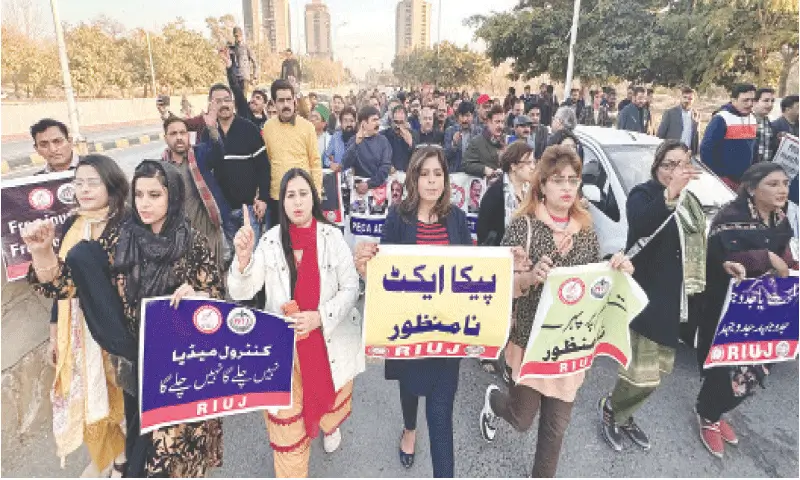
The PFUJ’s demand for the repeal of PECA cannot be ignored any longer. If unchecked, such legal harassment will not only muzzle independent journalism but also erode public trust in state institutions. Journalists are not criminals—they are watchdogs of democracy. Targeting them, especially women who already face gender-based barriers in media, is a dangerous escalation that Pakistan can ill afford.
The government must immediately withdraw these cases, hold the complainants and officials accountable, and ensure that laws are never again misused as tools of intimidation. Failure to do so will only fuel unrest, as PFUJ has warned of nationwide protests to safeguard press freedom.
A democracy without a free press is no democracy at all. Pakistan must choose whether it wants to uphold fundamental rights or continue down the path of suppression.
Source: Journalism Pakistan