
RMNP, IPI to Hold Online Training on Countering Online Harassment in Newsrooms on October 22
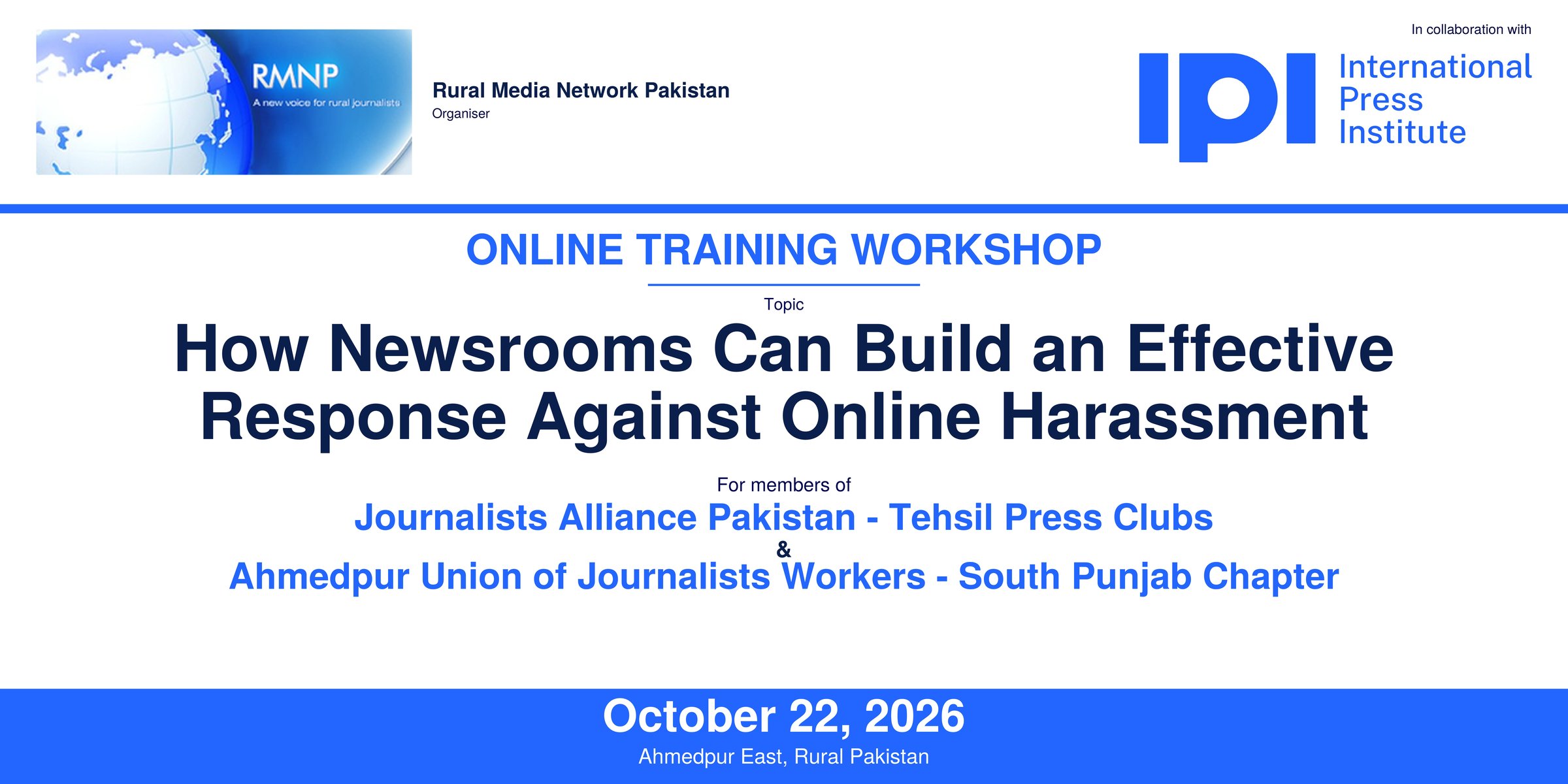
Javier Luque, IPI’s Head of Digital Media and Online Safety, to lead session for journalists in Ahmedpur East
Rural Media Network Pakistan (RMNP), in collaboration with the International Press Institute (IPI), will organise an online training workshop on Thursday, October 22, 2026, from 3pm to 5pm Pakistan Standard Time to strengthen journalists’ and newsrooms’ capacity to respond effectively to online harassment and abuse.
The workshop, titled “How Newsrooms Can Build an Effective Response Against Online Harassment,” is intended for members of the Tehsil Press Clubs affiliated with the Journalists Alliance Pakistan (JAP), Southern Punjab Chapter, and members of the Ahmedpur Union of Journalists Workers (AUJW).
Participants in Ahmedpur East will gather at Punjab College to join the online training session.
The session will be led by Javier Luque, Head of Digital Media and Online Safety at the International Press Institute (IPI), Austria. Ehsan Ahmed Sehar, President of RMNP and founder of the Journalists Alliance Pakistan, is coordinating the RMNP–IPI online training workshop.
The training will focus on practical measures newsrooms can adopt to protect journalists targeted by online abuse, reduce the emotional impact of harassment and safeguard their organisations’ reputations against smear campaigns.
According to information shared by IPI, the institute and Faktograf have developed an online masterclass for editors, newsroom managers and heads of audience. Drawing on best practices and experiences from experts in more than 40 newsrooms, the session aims to help media organisations establish clear and accessible protocols to prevent and respond to online harassment.
Four key areas of the training
1. Building an effective protocol: Initial steps
Participants will examine how to assess the impact of online harassment on newsroom staff and evaluate the strengths and weaknesses of existing protection measures. The objective is to identify gaps and establish a practical response protocol.
2. Prevention: Putting systems in place to minimise impact
This section will explore measures to reduce the likelihood and harm of online attacks. These include establishing formal and informal reporting mechanisms, encouraging journalists to report abuse, improving the moderation of abusive content on news websites and social media platforms, limiting journalists’ exposure to harmful material and protecting the media outlet’s reputation.
3. Recovery: Responding when attacks occur
Recognising that online attacks cannot be eliminated entirely, this section will explain how newsrooms can assess risks when incidents occur and plan an appropriate response. It will also cover support mechanisms, follow-up measures and reassessment to help journalists and media organisations recover from attacks.
4. Putting the protocol into practice
The final section will focus on adapting newsroom protocols to available resources and local working conditions. Participants will consider how to set priorities, introduce immediate and longer-term measures, manage implementation within existing resources and communicate new procedures effectively to newsroom staff.
The training aims to help journalists and media organisations move beyond ad hoc responses towards a systematic approach to online safety. Clear procedures for reporting abuse, prevention, risk assessment and recovery can help newsrooms better support targeted journalists and strengthen their institutional response.
The RMNP–IPI initiative forms part of RMNP’s efforts to strengthen the professional capacity and safety of journalists working in rural Pakistan.
RMNP #IPI #JournalistsSafety #OnlineHarassment #DigitalSafety #PressFreedom #RuralJournalism #JournalismTraining #NewsroomSafety #PakistanJournalists