The Glaring Absence of Female Journalists in Rural Pakistan
Structural Barriers, Missing Voices and the Role of Rural Media Institutions
Pakistan’s media landscape has expanded rapidly over the past two decades. Dozens of television channels, digital platforms, newspapers and FM radio stations now operate across the country. Despite this expansion, the participation of women in journalism remains extremely limited, particularly in rural areas where the majority of the country’s population resides.
The absence of women journalists in rural Pakistan has created a significant gap in news coverage. Important issues affecting rural women frequently remain unreported, while the national media narrative continues to be shaped largely by urban and male perspectives.
The issue is therefore not only a question of gender equality but also a matter of media credibility, representation and democratic accountability.
Recent research indicates that women journalists represent only a small fraction of Pakistan’s media workforce. Estimates suggest that Pakistan has roughly 20,000 working journalists, yet less than five percent are women.
1–Women in Pakistani Journalism: Current National Situation
Even within this small percentage, most female journalists are concentrated in large metropolitan centres such as Karachi, Lahore, and Islamabad. In many cases they work as television presenters or newsroom editors, while field reporting, investigative journalism and district correspondence remain overwhelmingly dominated by men.
Women’s representation in press clubs and journalists’ unions also reflects this imbalance. Major press clubs such as the National Press Club Islamabad and the Lahore Press Club have women members, but their numbers rarely exceed ten percent of the total membership. In smaller press clubs across the country, particularly in rural districts, female members are often extremely few or completely absent.
2-Rural Pakistan: A Major Gap in the Media System
Pakistan remains predominantly rural. Nearly 65 percent of the population lives outside large urban centres.
Yet the network of district correspondents that supplies news from rural areas to national newspapers and television channels remains almost entirely male dominated.
In rural districts, women journalists are estimated to represent only about one to two percent of working reporters.
In socially conservative communities where gender segregation is common, male journalists often cannot access women’s spaces or interview female victims of violence and discrimination. As a result, many incidents affecting rural women remain undocumented and invisible in the media.
3-South Punjab and the Bahawalpur Region
The situation is particularly visible in South Punjab.
The historic region of Bahawalpur, where Rural Media Network Pakistan and its parent newspaper Daily Nawa-i-Ahmedpur Sharqia are based, illustrates the structural imbalance in rural journalism.
The population of the former Bahawalpur State region exceeds 12 million people, with women constituting more than half of the population. Yet the number of women working as journalists in the region remains extremely small.
Press clubs in districts such as Bahawalpur, Rahim Yar Khan, Bahawalnagar, Lodhran and Khanewal have only a handful of women members. In many rural towns, there are no active female journalists at all.
For most women in these areas, employment opportunities remain limited to teaching, health services or small-scale informal work. Journalism is rarely considered a socially acceptable profession because it requires mobility, public interaction and engagement with male-dominated institutions.
4-Structural Barriers Facing Women Journalists
Several factors contribute to the absence of women journalists in rural Pakistan.
(a)-Cultural and Social Restrictions
In conservative rural communities, families often discourage women from entering professions that involve travel, late working hours or interaction with strangers.
(b)-Economic Challenges
Many rural journalists work as unpaid or poorly paid correspondents for newspapers and television channels. This insecure economic model discourages women from entering the profession.
(c)-Security Risks
Journalists working in rural districts frequently face pressure from powerful local actors including feudal landlords, political groups and criminal networks. For women journalists these risks are often compounded by harassment and social stigma.
(d)-Workplace Discrimination
Even in urban media organisations, women journalists often face gender bias and limited opportunities for professional advancement.
5-Impact on Coverage of Women’s Issues
The absence of women journalists has serious consequences for media coverage.
Many rural areas experience problems such as:
• honour killings
• domestic violence
• forced marriages
• workplace harassment
• trafficking and exploitation
Victims in such cases often feel more comfortable speaking with women reporters. When female journalists are absent, these stories frequently remain unreported or underreported.
This creates a significant information gap and weakens efforts to address human rights violations and gender discrimination.
6-RMNP’s Efforts to Strengthen Rural Journalism
For more than two decades, Rural Media Network Pakistan has worked to strengthen rural journalism and encourage the participation of women in the media sector.
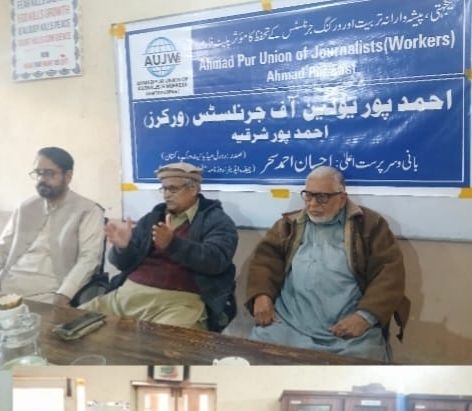
Together with Daily Nawa-i-Ahmedpur Sharqia, RMNP helped establish the Journalists Alliance of Press Clubs, a network consisting of 15 rural press clubs in South Punjab. The alliance was formed to strengthen cooperation among rural journalists and to promote professional training opportunities in remote districts.
Through this network and other initiatives, RMNP organised several training programmes that benefited both male and female journalists.
7-Major Journalism Training Initiatives
Commonwealth Journalists Association Training – 2003
In June 2003, RMNP organised a five-day journalism training programme in collaboration with the Commonwealth Journalists Association.
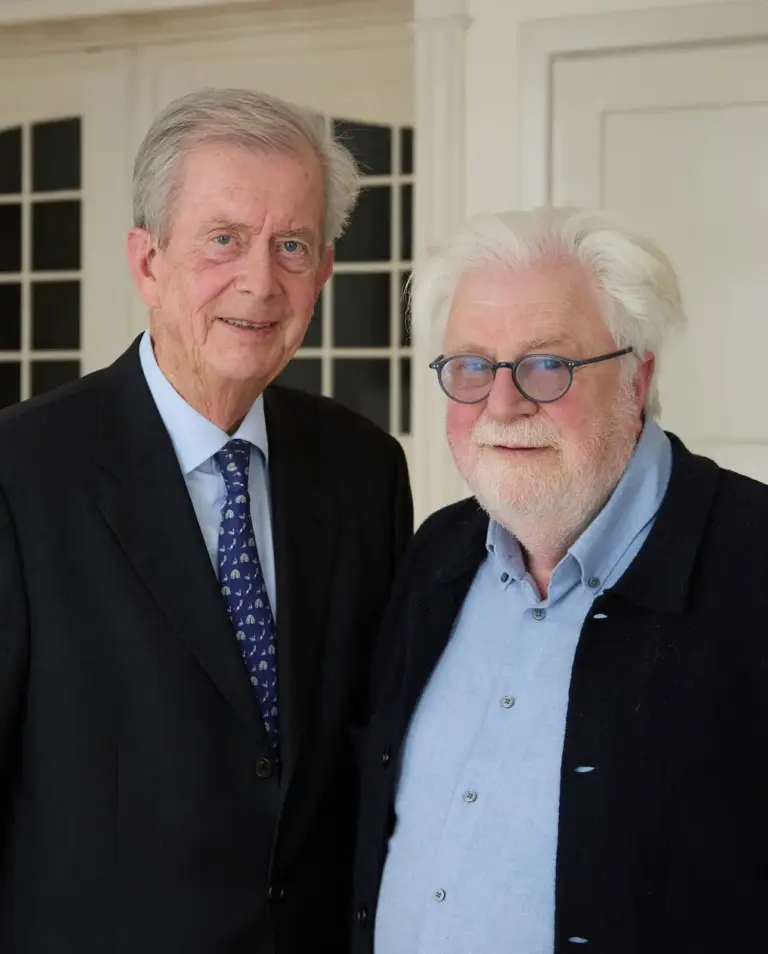
The training was conducted by the late British journalist, author and broadcaster Michael Griffin. Separate classrooms were arranged for male and female participants in order to encourage the participation of women from conservative rural communities.
Female Contributors Training – 2002
In 2002, RMNP organised a special training programme for female contributors with the support of UNESCO. The programme encouraged women from rural communities to contribute articles and reports to local newspapers.
Mixed Journalism Training – 2005
In 2005, RMNP organised a combined training programme for male and female journalists with the support of the German foundation Friedrich Ebert Stiftung.
Online Training for Female Journalists – 2009
In 2009, RMNP arranged online journalism training for female journalists with the support of UNESCO, introducing women reporters to internet-based communication and digital reporting tools.
Journalism Training for Media Students & Rural Female Contributors — 2011–12
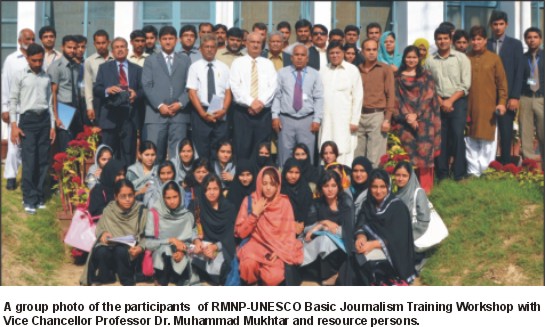
RMNP also organised three separate training programmes for female contributors in different far-flung areas while fourth combined training programme in collaboration with UNESCO at the Islamia University of Bahawalpur.
A total of 68 male and female students from the Department of Media Studies benefited from this initiative.
Seven Female Journalists of Riverine Areas Learn About Climate Change & Disaster Reporting 2013
Twenty four Journalists including seven female contributors hailing from riverside areas spent five days (July 4 to July 8, 2013 ) learning about climate change, the disasters it can precipitate, and how to report on the complex subject. This training was supported by UNESCO South Asia.
Journalists Safety Trainings – 2014–2015
Two workshops on journalist safety were organised in Musafirkhana and Samasatta during 2014–2015 with the support of UNESCO.
Doha Centre for Media Freedom Trainings – 2018
In 2018, RMNP organised two mixed journalism training programmes with the support of the Doha Centre for Media Freedom focusing on professional ethics and press freedom.
RMNP-UNESCO Safety of Journalists Training -2019
Two mixed trainings and journalists safety seminar organized in collaboration with UNESCO in 2019 attended by journalists hailing from Bahawalnagar, Rahimyarkhan and Bahawalpur districts.
8-Recognition of Women Journalists
RMNP has also recognised and honoured women journalists who have demonstrated professional courage and commitment.
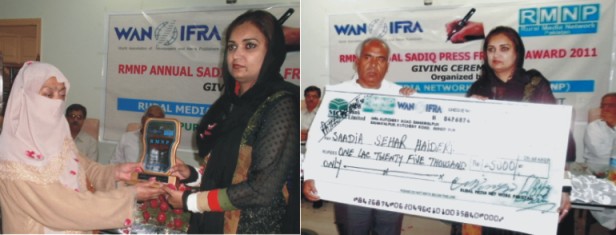
(a)-RMNP Sadiq Press Freedom Cash Award – 2011
In 2011, RMNP presented the Sadiq Press Freedom Cash Award, carrying a cash prize of US$1,500, to Sadia Haideri, an Islamabad-based female video journalist.
The award was supported by WAN-IFRA.
Sadia Haideri is the widow of Azizullah Haideri, who was killed in 2001 along with Western colleagues in Nangarhar Province, Afghanistan while working for Reuters.
(b)-RMNP Best Female Working Journalist Award – 2019
In 2019, Dr. Sadia Kamal received the RMNP Best Female Working Journalist Award, sponsored by UNESCO.
Sadia Kamal previously served as Senior Vice President of the National Press Club Islamabad and currently serves as President of the Pakistan Federal Union of Journalists Workers.
9-International Representation
RMNP has also facilitated international participation for Pakistani journalists.
In 2012, Hayyam Qayyum of the Pakistan Observer attended the UN Universal Periodic Review – Pakistan Session 2012 in Geneva as an RMNP nominee.
She participated along with:
• Wusatullah Khan of BBC/Dawn TV
• Shehzad Ahmed Khan, senior RMNP figure and media researcher.
10-Continuing the Legacy
A key figure behind many of RMNP’s initiatives for women journalists was the late Syeda Najmunnisa Bukhari, a retired principal who served as RMNP’s coordinator for women journalists. Her vision included the establishment of a Women Resource Centre to promote training, networking and professional development for rural women reporters.
Today, RMNP’s work continues under the coordination of Dr. Huma Qasim, a PhD scholar representing a younger generation of media researchers.
Conclusion
The absence of female journalists in rural Pakistan represents one of the most serious gaps in the country’s media system.
When half of the population remains largely invisible in news reporting, journalism cannot fully reflect social realities.
Encouraging rural women to enter journalism will not only promote gender equality but will also strengthen investigative reporting, human rights coverage and democratic accountability.
Through sustained efforts by institutions such as Rural Media Network Pakistan, the voices of rural women can gradually find their rightful place in Pakistan’s national media landscape.
Published in Urdu Language on The Eve of International Women Day